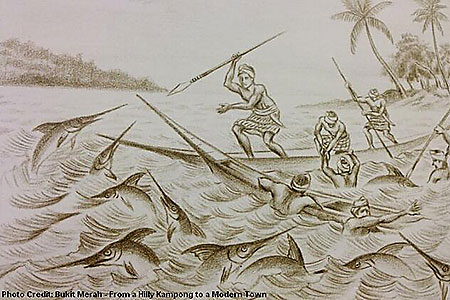
Everyone in Singapore thinks they know the story. Swordfish attack the shores of Temasek. A clever boy saves the people using banana trunks. He is praised, then killed out of jealousy. His blood turns red.
It is the version repeated in schools, media, and casual conversation.
But that is not the story many Malay elders actually inherited.

In the oral traditions passed down within the community, the swordfish incident exists, but it is not tied so neatly to Bukit Merah. The focus is not on a hill turning red. In fact, that detail is often missing entirely. What remains instead is something far more direct and far less mythologised.
According to elders who grew up hearing these stories within Malay households, the setting was simply a coastline of old Temasek. People were dying as swordfish leapt from the sea. The ruler’s men tried to stop them by forming a human barrier. It failed. Lives were lost.
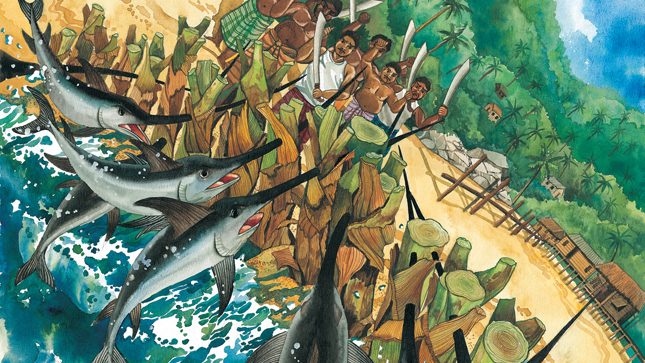
Then a young boy stepped forward. Not as a grand hero, but as someone who saw what others did not. He suggested using banana tree trunks. The swordfish struck, their snouts got lodged, and the attack ended.
The people were saved.
And that was exactly why he became a threat.
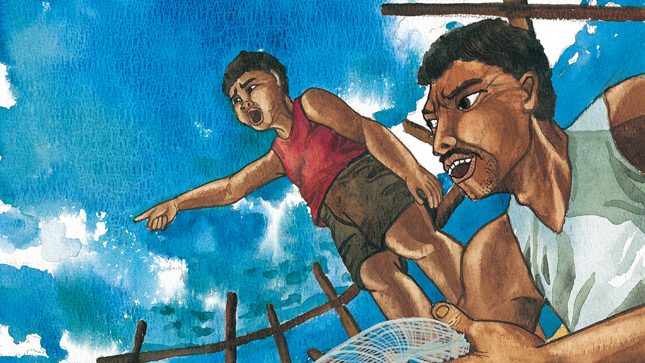
In these oral accounts, what followed was not a dramatic execution meant to teach a neat moral lesson. It was quieter and more deliberate. كبار orang istana began to worry. If a child could outthink them so publicly, what would happen when he grew older? What would that mean for their authority?
So they acted.
Not out of justice, but out of fear.
Some elders describe the boy being killed and discarded near the coast. Others recall that he was thrown into the sea. There was no spectacle. No moment where his blood stained the land to create. That detail, widely believed today, is not central to the older tellings.
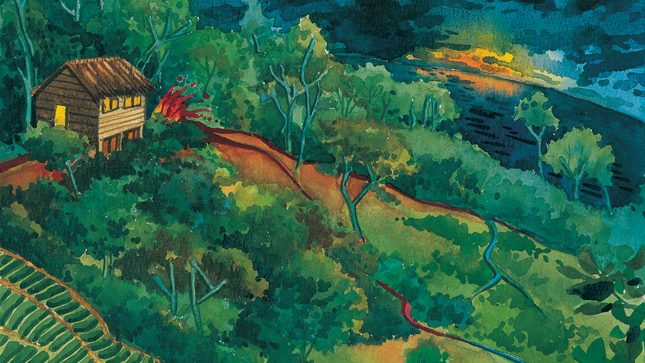
Even in, the core narrative exists without the now famous image of a hill turning red from blood. Which raises a simple question. If that detail is not present in earlier or orally preserved versions, why has it become the defining part of the story?
Because stories change depending on who tells them.
Over time, what many believe happened is that a political narrative about a boy eliminated for his intelligence became merged with a separate local legend explaining the name Bukit Merah. As the story was retold, simplified, and eventually taught more widely, the two became one.
According to those familiar with these oral traditions, what we have today is not necessarily false, but it is not untouched either. It is a version that has been shaped.
And this is where the issue goes beyond just one story.
When Malay history is told through external lenses, it often becomes flattened. Complex themes like fear of intelligence, manipulation of rulers, and the quiet removal of those seen as threats are overshadowed by symbolic elements. A hill turns red. A moral is packaged. A narrative feels complete.
But something important is lost in that process.
The versions preserved by elders are not just alternative takes. They carry a different emphasis. Less myth. More meaning. Less spectacle. More reality. They remind us that the story was never just about swordfish or a red hill. It was about power, and what happens when power feels threatened.
So the next time the story of is told, it is worth asking a simple question.
Are we hearing the original story, or just the most convenient version of it?
 The Indigenous Narrative